
Table of Contents
- Why Custom Work Hats Are Worth the Investment
- Quick Comparison: Popular Cap Styles for Work
- Custom Hat Embroidery vs Patch: Which Lasts Longer?
- Embroidered Work Hats for Construction: What to Look For
- How to Order: Logo Files, Placement, and Turnaround
- Care and Maintenance: Extending the Life of Your Hats
- Conclusion: Choosing the Right Provider for Your Team
- Frequently Asked Questions
Last Updated: September 5, 2026
A good work hat does more than block the sun. It turns your crew into a walking billboard, builds team identity on site, and survives the same abuse your boots do. The challenge is finding custom work hats with company logo options that hold up when the job gets rough, not just ones that look sharp in a product photo.
Most guides treat this as a simple transaction: pick a hat, upload a logo, check out. The reality is more nuanced. Fabric choice, decoration method, and logo file quality all determine whether your hats still look professional after a season of sweat, dirt, and washing. At Designed On Demand Supply Co., we build workwear for people who test their gear daily.
Below, we'll walk through the cap styles that actually perform on site, compare embroidery against patches, and give you a practical ordering checklist. You'll finish knowing precisely what to ask a provider before you spend a dollar on custom work hats.
Why Custom Work Hats Are Worth the Investment
Custom work hats with a company logo are one of the lowest-cost, highest-visibility branding tools available to any crew or business. A hat sits at eye level on every employee, travels to every job site, and gets seen by clients, subcontractors, and the public throughout the day. Unlike a shirt that gets covered by a hi-vis vest or jacket, a hat stays visible in nearly every work condition.
The branding value compounds with team cohesion. Crews wearing matching embroidered work hats for construction read as organized and professional before a single word is spoken. That impression matters when you're bidding on commercial work or meeting a new client on site.
There's also a practical argument for durability. A well-constructed work hat protects your employees from sun exposure during long outdoor shifts. The National Institute for Occupational Safety and Health guidance on sun safety recommends protective headwear for outdoor workers, making a quality hat part of basic job site safety rather than just a uniform accessory.
Consider the math on cost per impression. A hat worn five days a week for a year generates thousands of brand exposures for a one-time purchase. Few marketing investments deliver that kind of recurring visibility.
Quick Comparison: Popular Cap Styles for Work
Not every hat style suits every job. The right choice depends on your industry, the climate you work in, and whether the hat needs to fit under a hard hat or safety helmet.
Snapback caps offer an adjustable fit with a structured front panel. They're a solid all-around choice for supervisors, office staff who visit sites, and light-duty work. The flat brim can be curved to preference.
Trucker hats feature a mesh back that vents heat, making them the go-to for hot outdoor work like landscaping, roofing support, and road crews. The foam front panel holds embroidery well, and the breathable back keeps heads cooler in direct sun.
Traditional baseball caps with a curved brim and fabric or strapback closure remain the workhorse of the industry. They sit low profile, fit under many hard hat options, and look professional in client-facing roles.
Bucket hats are gaining traction among crews working in extreme sun, offering 360-degree brim coverage. They're less formal but highly functional for agricultural work and utility crews.
A quick reference for matching style to work environment:
| Cap Style | Best For | Key Feature | Logo Visibility |
|---|---|---|---|
| Snapback | Supervisors, management | Structured front, flat brim | High, front panel |
| Trucker | Hot outdoor work | Mesh back ventilation | High, foam front |
| Baseball cap | General crews, trades | Low profile, curved brim | Medium, front or side |
| Bucket hat | Extreme sun exposure | Full brim coverage | Medium, front panel |
Custom Hat Embroidery vs Patch: Which Lasts Longer?
Custom hat embroidery vs patch is the defining decision for workwear, and the answer depends on how the hat gets used. Direct embroidery stitches the logo directly into the fabric, creating a permanent bond that becomes part of the hat itself. Patches are sewn or heat-applied onto the surface.
For construction, HVAC, electrical, and other trades where hats face friction, abrasion, and regular washing, direct embroidery is the more durable option. The threads are anchored through the hat material, so there's no edge to catch, peel, or snag. A quality embroidery job on a structured cap can outlast the hat itself.
Patches have their place. A woven patch or leather patch delivers a premium, dimensional look that embroidery can't match. Leather patches in particular develop character over time and suit brands going for a rugged aesthetic. The tradeoff is vulnerability: patch edges can catch on equipment, and heavy washing can fray the stitching that holds the patch to the hat.
Consider the thread quality and stitch density. High-density embroidery with quality polyester thread resists fading and fraying far better than budget options. The American Apparel & Footwear Association's standards on product quality emphasize construction quality as the primary factor in garment longevity.
Embroidered Work Hats for Construction: What to Look For
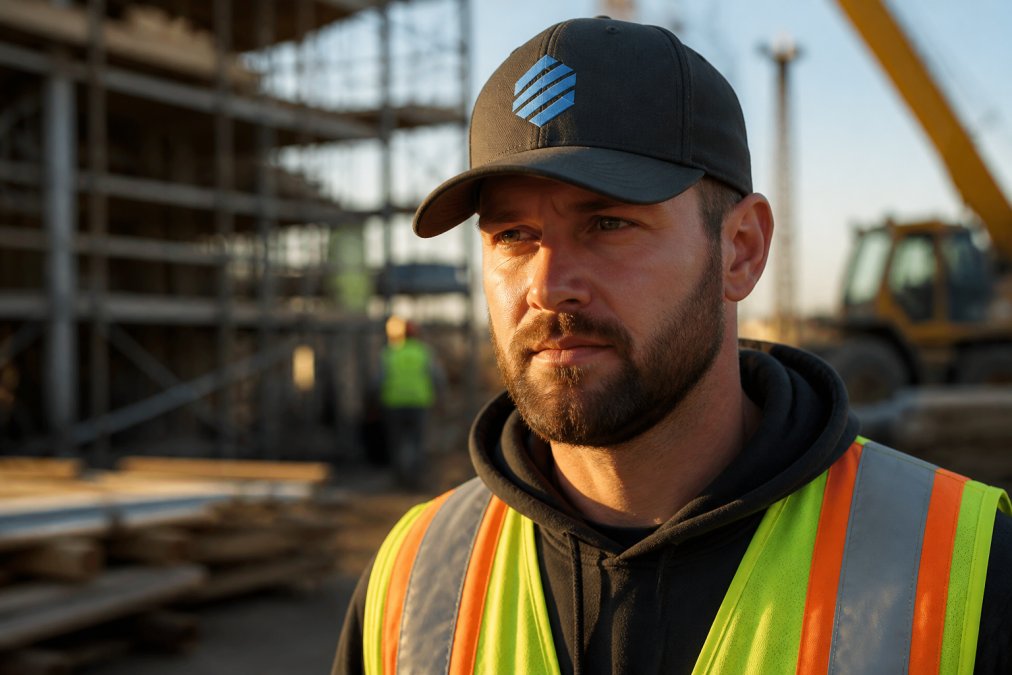
Embroidered work hats for construction need specific features that office-branded caps simply don't require. Focus on fabric, construction, and closure before you even think about the logo.
Fabric matters first. Look for cotton twill or a cotton-poly blend with a structured front. Pure polyester hats trap heat and look shiny after repeated washing. A brushed cotton twill feels substantial, breathes reasonably, and takes embroidery cleanly without puckering.
Construction quality shows in the seams. Turn the hat inside out. Are the panels reinforced? Is the sweatband attached securely? A hat that costs less upfront but loses its shape after ten washes is the more expensive purchase in the long run. Reinforced stitching at stress points, particularly where the brim meets the crown, prevents the structural failure that ruins most cheap hats.
The closure system affects daily comfort. Snapbacks offer quick adjustment but can feel bulky under a hard hat. Hook-and-loop closures lie flat and adjust easily. Elastic fitted options stretch but lose tension over time. For crews that share equipment, an adjustable closure is more practical than fitted sizes.
Color matching matters for brand identity. If your logo uses specific brand colors, confirm the provider can match thread to your specifications. The Pantone Color Institute's guide to brand color consistency explains why consistent color reproduction is critical for brand recognition.
How to Order: Logo Files, Placement, and Turnaround
Ordering custom work hats with a company logo runs smoothly when you prepare the right artwork and know your timeline. The process breaks down into three stages: file preparation, design approval, and production.
Logo file requirements are the most common stumbling block. Providers need vector artwork, typically an .ai.eps, or .svg file, to digitize the logo for embroidery. Vector files use mathematical paths rather than pixels, so they scale to any size without losing sharpness. If you only have a JPEG or PNG, ask your provider about file conversion services before you order. A low-resolution logo produces a blurry, unprofessional result that reflects poorly on your brand.
Digitization is a separate step from embroidery. The provider converts your vector artwork into a stitch file that tells the embroidery machine where to place each thread. Complex logos with fine text or gradients often require simplification for thread work. A good digitizer will flag problem areas and suggest adjustments that keep your logo recognizable at hat size.
Logo placement options vary by hat style. The front panel is the standard choice, typically running 3.5 to 4 inches wide. Side and back placements work for secondary branding, like a website URL or a crew member's name. For maximum impact, front placement with a contrasting thread color delivers the clearest read from a distance.
Turnaround time depends on quantity and decoration method. Embroidery production typically takes longer than printing because each hat goes through the machine individually. Factor in digitization time, production days, and shipping when planning for a project start date or company event.
| Order Step | What You Need | Typical Timeline |
|---|---|---|
| Artwork prep | Vector file (.ai.eps.svg) | 1-2 days |
| Digitization | Logo converted to stitch file | 1-3 days |
| Proof approval | Digital mock-up review | 1-2 days |
| Production | Embroidery or patch application | 5-10 business days |
| Shipping | Ground or expedited | 2-5 days |
Care and Maintenance: Extending the Life of Your Hats
A quality custom work hat lasts years with proper care, but most hats die early from washing machine abuse. The number one mistake is tossing hats into a standard laundry cycle with heavy work clothes.
Hand washing is the gold standard. Fill a sink with cool water and a small amount of mild detergent. Submerge the hat, gently scrub the sweatband and any soiled areas with a soft brush, then rinse thoroughly. Reshape the crown and brim, and let it air dry away from direct heat.
Machine washing destroys structure. The agitation of a washing machine breaks down the hat's internal stiffening, causing the crown to collapse and the brim to warp. If you must machine wash, use a hat form or a dedicated hat washing cage, run a gentle cycle with cold water, and always air dry. Never put a hat in the dryer, as the heat shrinks the fabric and can crack or distort embroidery thread.
Spot cleaning handles most daily grime. A damp cloth with mild soap removes dust, mud splatter, and sweat stains without a full wash. For salt stains from sweat, a solution of cool water and white vinegar applied with a cloth breaks down the residue without damaging the fabric.
Store hats properly between shifts. Hang them on a hook or place them crown-up on a shelf. Never leave hats crumpled on a truck seat or dashboard, where heat and UV exposure fade the fabric and degrade the embroidery thread over time.
Conclusion: Choosing the Right Provider for Your Team
The best custom work hats with a company logo come from a provider that understands the difference between a promotional product and a piece of work gear. You need durable fabrics, quality embroidery that survives the job site, and a partner who treats your brand identity with the same care you do.
Designed On Demand Supply Co. builds custom workwear for people who test their gear daily. We offer custom design services for hats and apparel, use high-quality standards for everyday gear, and focus on durable workwear that holds up through real job site conditions. We can help you take a rough logo idea and turn it into a finished product your crew will actually wear.
Get started with Designed On Demand Supply Co. and outfit your team with hats built to work as hard as you do.
Frequently Asked Questions
What is the minimum order quantity for custom work hats?
Minimum order quantities vary widely by provider. Some specialized embroidery shops offer no MOQ, letting you order a single hat for around $20 per unit. Others, especially bulk wholesalers, may require a minimum of 36 hats to unlock lower per-unit pricing. If you need just a few hats for a small crew, look for a provider with no minimum. For larger teams, bulk ordering will always deliver better pricing.
How much do custom work hats with company logo cost?
Pricing depends on the hat style, decoration method, and quantity ordered. Some providers advertise entry-level pricing under $10 per unit for large bulk orders, while others use flat all-in pricing around $20 per hat that includes the cap, logo, and digitization. For accurate numbers, request quotes from several suppliers. Be sure to compare setup fees and digitization charges, which some companies hide in the final price.
Which lasts longer on a work hat: embroidery or a patch?
Both methods can hold up well, but the answer depends on the patch type. Direct embroidery sews thread directly into the hat fabric and is the most durable option for rough daily use. Woven patches are also tough, but leather patches can crack or fade with heavy sweat and washing. For construction and trade work, direct embroidery is the safest choice because there is nothing to snag or peel away from the hat.
What are the most durable hat styles for construction and trade work?
The classic six-panel structured cap, often called a work cap or baseball cap, is the standard for construction crews. Look for styles like the Richardson 112, which is a popular choice across the industry. These hats typically feature a cotton or polyester blend that handles sweat and repeated washing. Snapback closures also hold up better than Velcro, which tends to lose its grip over time.